

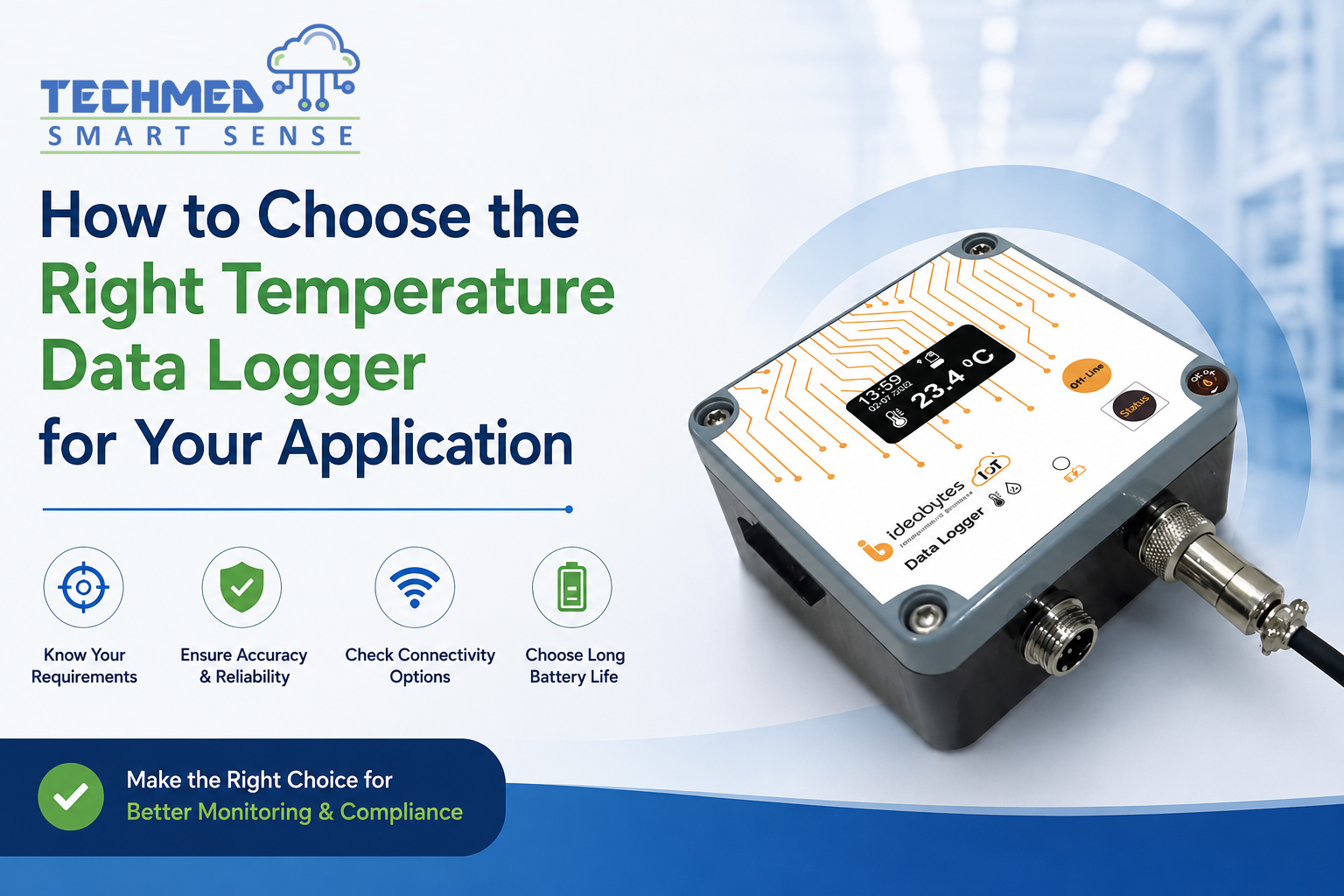
A temperature data logger is a small device, but choosing the wrong one can create a big problem.
A logger used for a pharmaceutical refrigerator may not be suitable for a cold room. A device designed for simple offline recording may not be enough for a facility that needs 24/7 remote alerts.
So before buying a temperature data logger in Delhi, it is important to understand what your application actually requires.
Start With Your Application
First, ask yourself one simple question:
What exactly am I trying to monitor?
Your requirement could be:
- Medical refrigerator
- Vaccine refrigerator
- Blood bank
- IVF laboratory
- Pharmaceutical cold room
- Warehouse
- Cold-chain transportation
- Laboratory
- Food storage
- Industrial equipment
The application determines the temperature range, accuracy, sensor type, connectivity, and reporting features you need.
The WHO recognizes several types of temperature monitoring devices for different cold-chain applications, from basic temperature recorders to advanced monitoring and alarm systems.
1. Check the Temperature Range
This should be the first specification you check.
A refrigerator, freezer, cold room, and industrial process can all operate at completely different temperatures.
Don’t simply choose a logger because its advertised range looks large. Make sure the sensor is suitable for the actual temperature range you need to monitor.
For pharmaceutical and cold-chain applications, the logger should provide reliable measurements across the range relevant to your products and equipment.
2. Look at Accuracy
Accuracy matters when even a small temperature change can affect a product.
Before purchasing, check:
- Measurement accuracy
- Resolution
- Sensor type
- Calibration range
- Calibration certificate availability
For critical applications, calibration should be part of your monitoring plan. Sensors can drift over time, so periodic calibration helps maintain confidence in the readings.
3. Decide Between Offline and Remote Monitoring
This is where many buyers get confused.
Offline Data Logger
An offline logger stores readings inside the device.
It can be a good choice when:
- Internet connectivity isn’t required
- Data is downloaded periodically
- You need portable monitoring
- Real-time alerts aren’t essential
Wi-Fi or 4G Data Logger
A connected logger can send readings to a cloud platform and allow remote monitoring.
This is useful when you need:
- 24/7 monitoring
- Remote access
- Instant alerts
- Cloud data storage
- Multiple-location monitoring
For critical environments, a connected temperature monitoring device in Delhi can provide an additional layer of protection.
4. How Often Should It Record?
The logging interval determines how frequently the device records temperature.
For example, a refrigerator may need regular readings throughout the day, while a process application may require much more frequent recording.
Choose the interval according to the risk and application rather than simply selecting the fastest available setting.
5. Do You Need Temperature or Temperature + Humidity?
If temperature is your only concern, a temperature-only logger may be enough.
But warehouses, laboratories, pharmaceutical storage areas, and certain production environments may also need humidity monitoring.
In that case, a temperature and humidity data logger can provide a more complete picture of the environment.
6. Check the Memory Capacity
Memory determines how long the logger can record before the data needs to be downloaded or synchronized.
Think about your actual usage:
Will someone download the data every week, every month, or only occasionally?
If the logger is being used for long-term monitoring, choose sufficient memory or consider a cloud-connected system.
7. Don’t Forget Alerts
Recording a problem is useful.
Knowing about the problem immediately is even better.
For applications such as pharmaceutical storage, vaccine refrigerators, blood banks, and cold rooms, consider a system that can alert staff when temperature moves outside predefined limits.
Depending on the system, alerts may be available through SMS, email, mobile applications, or a local alarm.
8. Consider Battery Life
For portable or standalone applications, battery life can make a major difference.
Check:
- Expected battery life
- Battery replacement options
- What happens during a power failure
- Whether the logger continues recording when connectivity is lost
For fixed monitoring systems, battery backup can be particularly useful during power interruptions.
9. Think About Calibration and Compliance
If the logger is being used for a quality-critical or regulated application, don’t treat calibration as an optional extra.
Ask the supplier:
- Is a calibration certificate provided?
- What temperature points are covered?
- Is recalibration available?
- What is the recommended calibration interval?
- Is the software suitable for your documentation requirements?
The WHO provides temperature mapping tools specifically designed for cold-chain equipment and storage areas, demonstrating how calibrated data loggers can be used to understand temperature distribution.
Which Data Logger Should You Choose?
| Application | Suitable Solution |
|---|---|
| Basic refrigerator | Offline temperature logger |
| Vaccine refrigerator | Logger with alerts |
| Medical refrigerator | Continuous temperature monitoring |
| Cold room | Wi-Fi or 4G monitoring |
| Pharmaceutical storage | Connected logger with reporting |
| Cold-chain transportation | Portable temperature logger |
| Laboratory | Temperature or temperature + humidity logger |
| Multiple locations | Cloud-based multi-point monitoring |
Remember, there is no single “best” data logger for every application. The right device depends on what you are monitoring and how quickly you need to know about a problem.
Why Choose Techmed Smart Sense?
Techmed Smart Sense provides monitoring solutions for healthcare, pharmaceutical, laboratory, cold-chain, and industrial applications.
Solutions include:
- Temperature Data Loggers
- Temperature & Humidity Data Loggers
- Wi-Fi Data Loggers
- 4G Remote Data Loggers
- Cold Room Monitoring
- Medical Refrigerator Monitoring
- Vaccine Refrigerator Monitoring
- Blood Bank Monitoring
If you’re comparing data loggers in Delhi, Techmed Smart Sense can help you select a solution based on your temperature range, monitoring location, connectivity, alert requirements, and reporting needs.
Final Checklist Before Buying
Before placing your order, check these eight things:
- Temperature range
- Accuracy
- Logging interval
- Memory capacity
- Connectivity
- Alerts
- Battery life
- Calibration and reporting
Getting these basics right will help you avoid buying a logger that looks good on paper but doesn’t fit your actual application.
Conclusion
Choosing a temperature data logger isn’t simply about finding the cheapest device or the one with the most features.
Start with your application, understand the risks, and then select the logger accordingly.
For a simple refrigerator, an offline logger may be perfectly adequate. For pharmaceutical cold rooms, vaccine storage, blood banks, or other critical environments, remote monitoring and real-time alerts may be worth considering.
If you’re looking for a temperature data logger in Delhi, Techmed Smart Sense offers different monitoring solutions for healthcare, pharmaceutical, laboratory, cold-chain, and industrial applications.
Frequently Asked Questions
What is the most important factor when choosing a temperature data logger?
The most important factor is whether the logger is suitable for your application, including the required temperature range, accuracy, recording interval, and monitoring environment.
Should I choose an offline or Wi-Fi data logger?
Choose an offline logger when periodic data collection is sufficient. Choose Wi-Fi or 4G monitoring when you need remote access and real-time alerts.
Do temperature data loggers need calibration?
For critical and regulated applications, calibration and traceability are important. The required approach depends on your application and quality requirements.
Can one data logger monitor temperature and humidity?
Yes. Combined temperature and humidity data loggers are available for applications where both parameters need to be monitored.
Can I monitor a temperature data logger remotely?
Yes. Wi-Fi and 4G-connected systems can transmit readings to a remote platform, allowing users to monitor conditions without being physically present.