

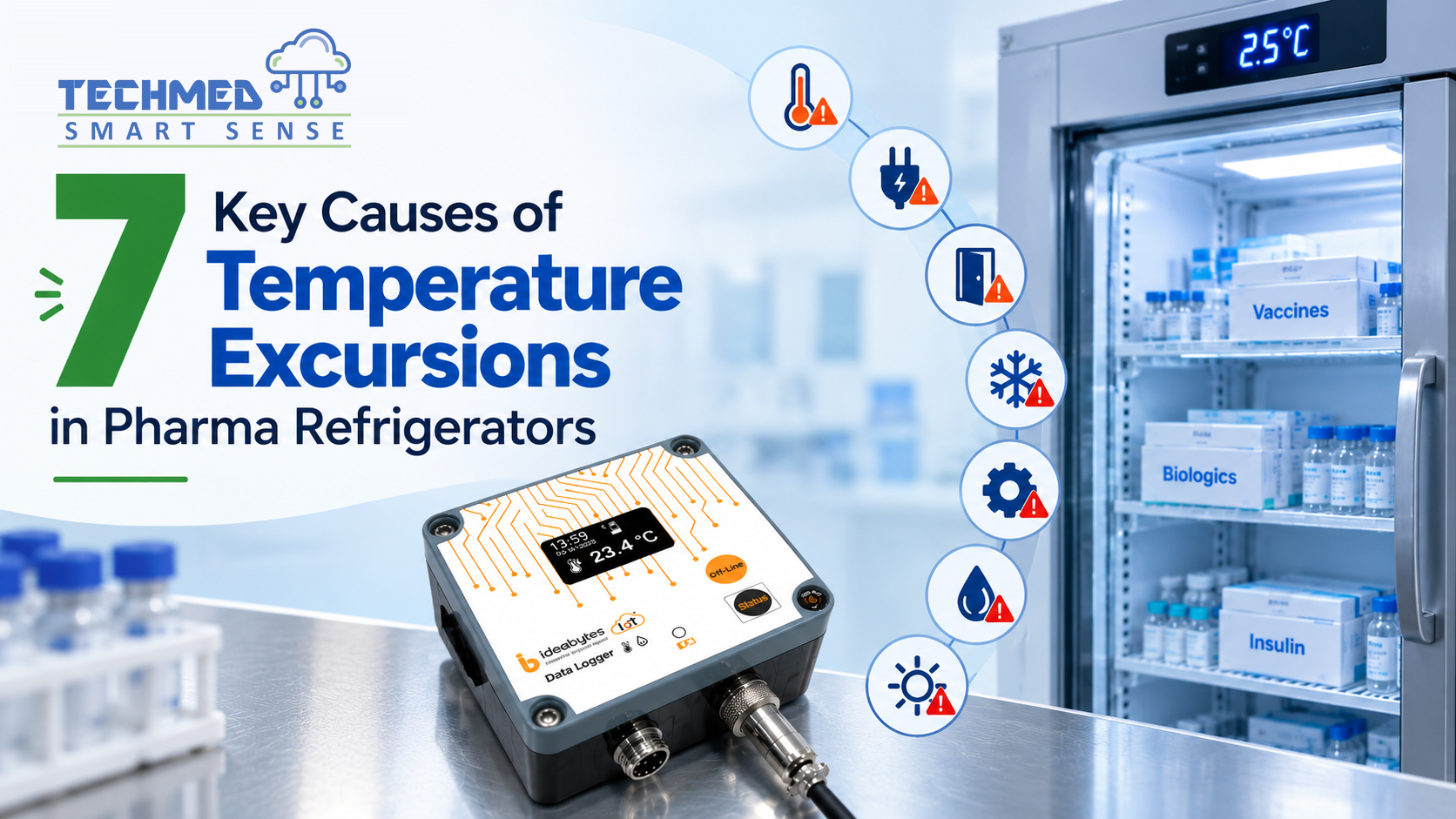
A pharmaceutical refrigerator can show the correct temperature in the morning and still have a serious problem.
Maybe the door was left open overnight. Maybe there was a power cut. Maybe the compressor stopped working for a few hours. Without continuous monitoring, you may never know exactly when the problem started.
For medicines, vaccines, and other temperature-sensitive products, these unnoticed changes can lead to product loss and unnecessary investigation.
So, what actually causes temperature excursions in pharmaceutical refrigerators?
1. Refrigerator Door Left Open
This is one of the simplest—and most common—causes.
A refrigerator door that remains open for too long allows warm air to enter. If this happens repeatedly, the internal temperature can move outside the required range.
Busy hospital pharmacies and laboratories are particularly vulnerable because refrigerators may be opened frequently throughout the day.
2. Power Failure
A power cut can stop the refrigeration system completely.
If the outage lasts long enough, the internal temperature can gradually rise. The problem becomes even more serious when a power failure occurs at night or when nobody is present.
A temperature monitoring device Delhi can provide an alert when conditions start moving outside the configured limits.
3. Compressor or Cooling System Problems
The compressor is essential for maintaining the refrigerator’s temperature.
Issues such as:
- Compressor failure
- Fan malfunction
- Refrigerant problems
- Poor maintenance
- Blocked airflow
can cause the refrigerator to struggle to maintain its set temperature.
Regular maintenance can help identify these issues before they result in a major temperature excursion.
4. Faulty Temperature Sensor
Sometimes the refrigerator is working correctly—but the sensor isn’t.
A damaged, poorly positioned, or inaccurate sensor can provide incorrect readings. This can make it difficult to know the actual conditions inside the refrigerator.
That is why sensor quality and periodic calibration are important for critical applications.
5. Overstocking the Refrigerator
Filling a refrigerator beyond its recommended capacity can restrict airflow.
When cold air cannot circulate properly, some areas may become warmer than others.
Good storage practices and appropriate product spacing help maintain more consistent conditions.
6. Frequent Door Opening
Opening the refrigerator occasionally is normal.
But repeated opening throughout the day can cause temperature fluctuations, particularly when the surrounding environment is warm.
Staff should avoid unnecessary door opening and ensure the door closes properly after every use.
7. Incorrect Temperature Settings
A refrigerator may also experience excursions because the temperature settings are incorrect.
Accidental changes to the thermostat or incorrect configuration can cause the unit to operate outside the required range.
Temperature monitoring can help identify these deviations quickly.
8. Poor Preventive Maintenance
A refrigerator that hasn’t been serviced properly is more likely to develop problems.
Regularly check:
- Door seals
- Compressor
- Fans
- Sensors
- Cooling performance
- Electrical connections
Preventive maintenance is much easier—and usually less costly—than dealing with damaged temperature-sensitive products.
How Can You Detect Temperature Excursions?
Manual temperature checks only tell you what is happening at the moment someone checks the refrigerator.
A data logger continuously records temperature, creating a history of what happened throughout the day and night.
Modern systems can also send alerts when temperature crosses predefined limits.
With data loggers in Delhi, pharmaceutical facilities can continuously monitor refrigerators and receive timely notifications when abnormal temperature changes occur.
Why Real-Time Monitoring Helps
Imagine the temperature starts rising at 2 AM.
Without remote monitoring, the issue may remain unnoticed until employees arrive in the morning.
With a connected monitoring system:
Temperature rises → system detects deviation → alert is generated → staff receives notification → corrective action is taken.
This can significantly reduce the time between a temperature problem occurring and someone responding to it.
Where Can This Monitoring Be Used?
Temperature monitoring is useful for:
- Pharmaceutical refrigerators
- Vaccine refrigerators
- Medical refrigerators
- Blood bank refrigerators
- Laboratory refrigerators
- IVF laboratories
- Pharmaceutical storage areas
Techmed Smart Sense provides solutions including temperature data loggers, Wi-Fi monitoring, 4G monitoring, and remote temperature monitoring.
With Smart Sense Data Logger Delhi, facilities can keep track of temperature conditions without depending entirely on manual checks.
Conclusion
Temperature excursions don’t always happen because the refrigerator suddenly stops working.
Sometimes the cause is as simple as an open door. Other times, the problem may be related to power, sensors, cooling equipment, airflow, or maintenance.
The important thing is to detect the problem early.
Continuous temperature monitoring helps pharmaceutical facilities understand what is happening inside their refrigerators and respond before a small temperature deviation becomes a costly problem.