
Businesses often lose money because of problems they discover too late.
A refrigerator stops maintaining the required temperature. A cold room develops a cooling issue. A machine operates outside its normal range. Or a temperature-sensitive product is exposed to unsuitable conditions for several hours.
By the time someone notices the problem, the damage may already be done.
This is where IoT-based monitoring can make a difference.
What Is IoT Monitoring?
IoT monitoring connects sensors and data loggers to a digital monitoring system.
Instead of manually checking equipment at regular intervals, businesses can collect data continuously and view it remotely.
For example, a temperature monitoring system can track conditions inside:
- Pharmaceutical refrigerators
- Cold rooms
- Medical storage areas
- Laboratories
- Warehouses
- Food storage facilities
- IVF laboratories
The collected information can then be used to identify problems and take action quickly.
1. Reduce Product Loss
Temperature-sensitive products can be damaged when storage conditions move outside their required range.
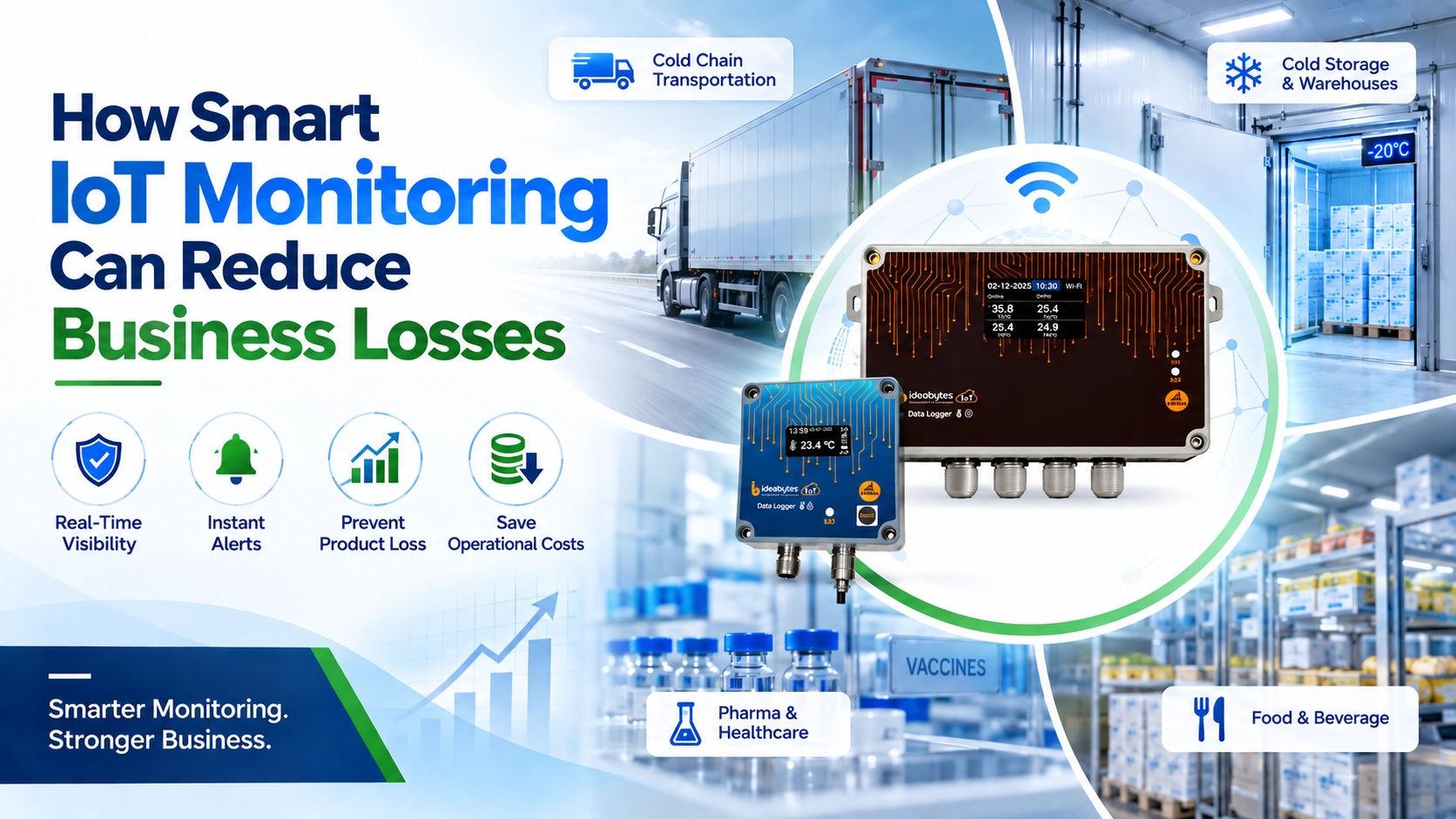
A real-time temperature monitoring system can send an alert when the temperature crosses a predefined limit.
This gives staff an opportunity to investigate the problem before products are affected.
2. Reduce Manual Monitoring
Traditional monitoring often depends on employees checking displays and recording readings manually.
This takes time and can also result in missed readings.
With an IoT data logger, measurements can be recorded automatically and stored digitally, reducing the need for repetitive manual checks.
3. Identify Problems Earlier
Continuous data can reveal changes that may not be obvious during a quick inspection.
For example, repeated temperature fluctuations could indicate:
- Cooling performance problems
- Frequent door opening
- Power interruptions
- Sensor issues
- Equipment requiring maintenance
Finding these patterns early can help businesses investigate the cause before a larger failure occurs.
4. Monitor Multiple Locations Remotely
For businesses operating multiple refrigerators, cold rooms, laboratories or storage areas, checking every location physically can be difficult.
Cloud-based monitoring allows authorized users to view data from different locations through a centralized platform.
This is particularly useful for organizations managing several facilities.
5. Get Alerts When Action Is Needed
A monitoring system becomes more useful when it doesn’t just collect data but also informs the team when something requires attention.
Depending on the system, businesses can receive alerts for temperature excursions, connectivity problems or other predefined conditions.
This helps teams focus on situations that actually require action.
6. Use Historical Data for Better Decisions
IoT monitoring also creates a record of operating conditions over time.
Historical data can help businesses understand:
- When temperature problems occur
- How frequently excursions happen
- Whether equipment is performing consistently
- Whether corrective actions worked
- Where monitoring improvements are required
Instead of relying only on assumptions, teams can use actual recorded data.
IoT Monitoring Is About More Than Technology
The real value of IoT is not simply connecting a sensor to the internet.
The goal is to turn continuous data into useful information.
For temperature-sensitive operations, this means knowing what is happening, receiving an alert when something goes wrong, and having historical records to understand what happened.
Techmed Smart Sense provides <a href=”https://techmedsmartsense.com/”>temperature data loggers and monitoring solutions in Delhi</a> for applications including pharmaceutical storage, healthcare, laboratories, cold rooms and other temperature-sensitive environments.
Conclusion
Small operational problems can become expensive when they are discovered late.
IoT monitoring helps businesses move from manual checking to continuous visibility. With automated data collection, remote access, alerts and historical records, businesses can respond faster and make better operational decisions.
For companies handling temperature-sensitive products or equipment, smart monitoring can be an important part of reducing avoidable losses and improving day-to-day operations.