
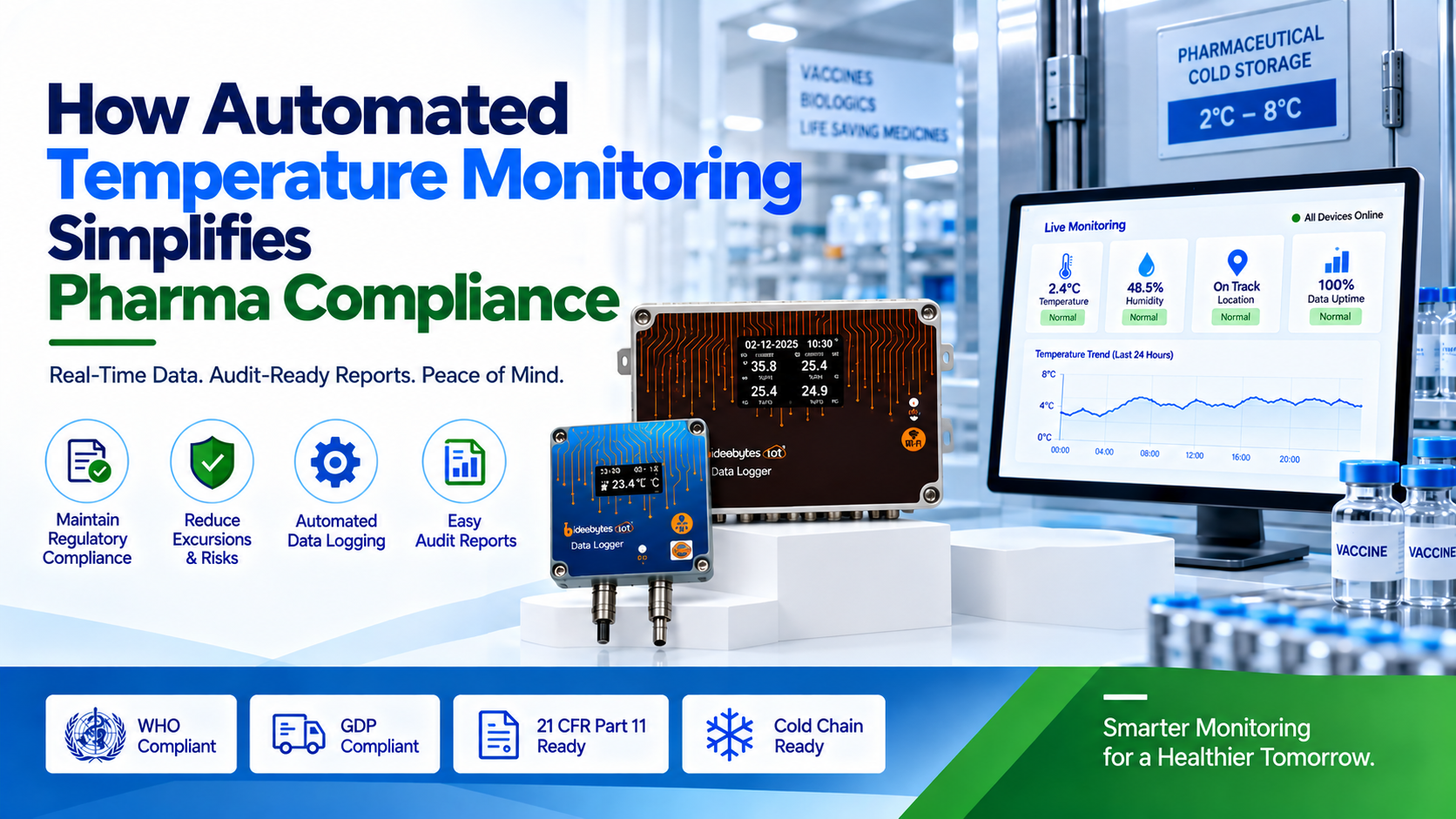
Pharmaceutical companies deal with two responsibilities at the same time: protecting product quality and maintaining reliable records.
Temperature-sensitive medicines, vaccines, samples, and raw materials may need controlled environmental conditions throughout storage and manufacturing. The challenge becomes much greater when monitoring is spread across multiple rooms, refrigerators, warehouses, or facilities.
Manual temperature logs can make this process harder to manage.
The Problem With Manual Temperature Records
A traditional monitoring process may involve employees checking temperature displays and entering readings into spreadsheets or paper logs.
This creates several practical problems:
- Readings can be missed
- Records may contain manual errors
- Temperature deviations may be noticed late
- Finding historical information can take time
- Preparing documentation for audits becomes more difficult
When hundreds or thousands of monitoring points are involved, managing everything manually becomes increasingly complicated.
How Automated Monitoring Changes the Process
An automated temperature monitoring system continuously records environmental conditions and stores the information digitally.
Instead of depending entirely on periodic manual checks, businesses can have a continuous record of temperature and other monitored parameters.
For pharmaceutical facilities, this can provide better visibility across:
- Storage rooms
- Pharmaceutical refrigerators
- Cold rooms
- Warehouses
- Clean areas
- Laboratories
- Production areas
Real-Time Alerts Can Help Teams Respond Faster
Recording temperature is only one part of monitoring.
The bigger question is: What happens when the temperature goes outside the acceptable range?
With a connected monitoring system, predefined limits can trigger alerts. Depending on the system configuration, notifications can be delivered through channels such as email or SMS.
This allows responsible teams to investigate the situation sooner rather than discovering the problem during the next manual inspection.
Digital Records Make Audits Easier
Pharmaceutical compliance requires more than simply having temperature readings.
Organizations may need to demonstrate when data was recorded, what happened to the data, and who performed relevant actions.
Electronic records, audit trails, controlled access and automated reporting can make this information easier to organize and review. FDA 21 CFR Part 11 is specifically concerned with electronic records and electronic signatures in regulated environments.
A properly designed monitoring system can therefore help reduce the administrative effort involved in preparing monitoring documentation.
Calibration Is Also Important
Even the best monitoring system depends on reliable sensors.
Regular calibration helps verify that measurement devices are providing accurate readings. Keeping calibration information organized alongside monitoring data can make it easier for quality teams to manage equipment and identify when sensors require attention.
One System for Multiple Monitoring Points
For larger pharmaceutical operations, having different monitoring methods at different locations can create unnecessary complexity.
A centralized monitoring platform can bring data from multiple devices into one dashboard.
This can help teams:
- View current conditions
- Review historical readings
- Investigate alarms
- Generate reports
- Track multiple monitoring locations
- Maintain better visibility across facilities
What Should a Pharma Monitoring System Include?
When evaluating a monitoring solution, pharmaceutical businesses should consider features such as:
Continuous data logging – Records measurements automatically.
Real-time alerts – Notifies the responsible team when predefined limits are exceeded.
Cloud or centralized access – Allows authorized users to review information remotely.
Historical records – Makes it easier to investigate previous events.
Audit trails – Helps maintain traceability of relevant system activities.
Calibration management – Supports sensor accuracy and maintenance processes.
Compliance-ready reporting – Helps organize monitoring information for quality and audit requirements.
Why This Matters Beyond Compliance
Compliance is important, but automated monitoring can also improve everyday operations.
When teams have reliable real-time information, they can identify temperature problems earlier, reduce repetitive manual work, investigate deviations more efficiently, and maintain better records.
For pharmaceutical and healthcare facilities looking for <a href=”https://techmedsmartsense.com/”>temperature monitoring solutions in Delhi</a>, Techmed Smart Sense provides data logging and remote monitoring solutions for temperature-sensitive environments.
Conclusion
Pharmaceutical temperature monitoring is no longer simply about writing down a temperature reading every few hours.
As facilities become larger and monitoring requirements become more demanding, automated systems can provide continuous data, alerts, centralized visibility and organized records.
The right monitoring setup can help pharmaceutical businesses maintain better control over their storage and environmental conditions while making compliance-related documentation easier to manage.