

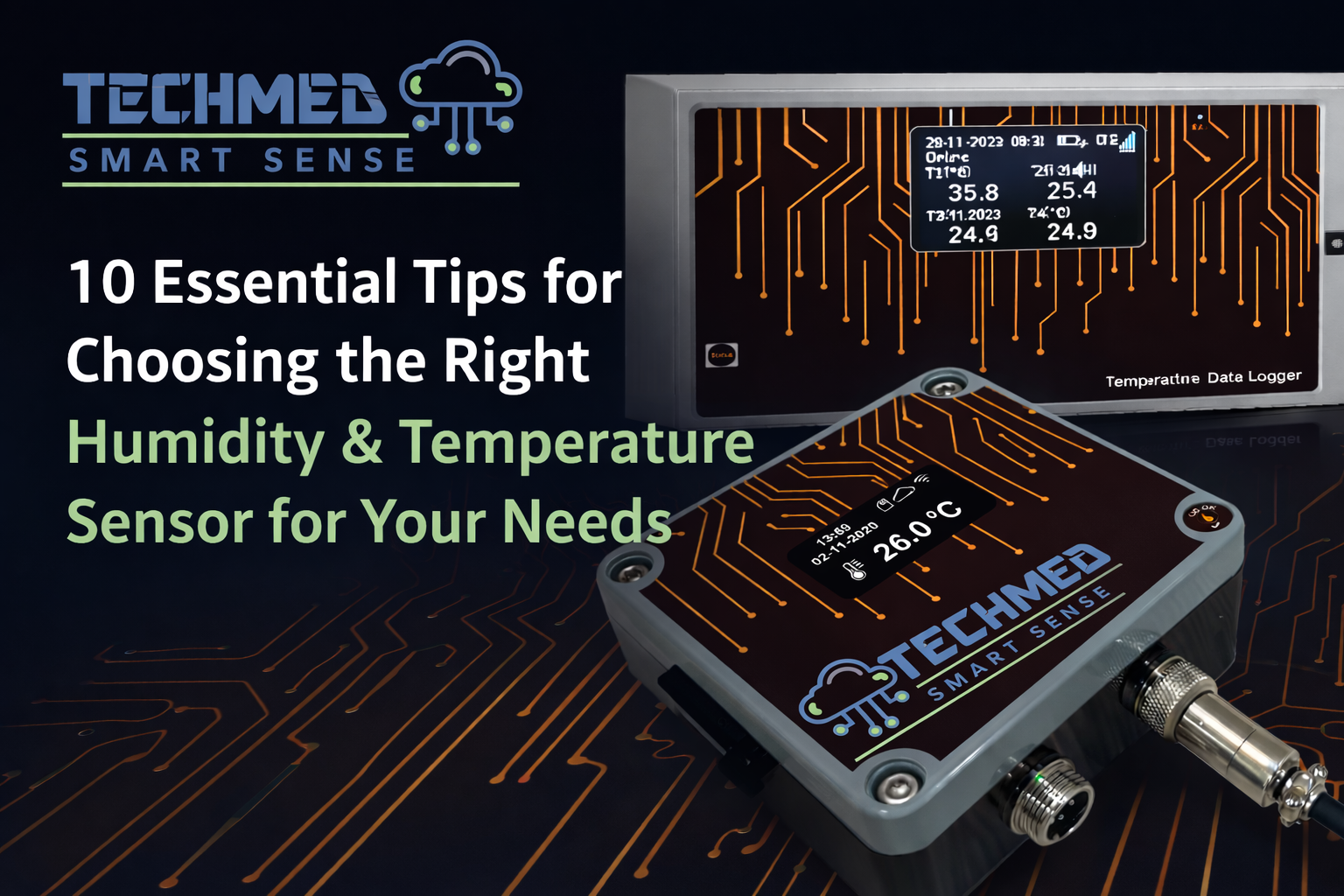
Choosing the right humidity and temperature sensor is critical for maintaining product quality, safety, and compliance—especially for businesses operating in Delhi’s demanding climate. Industries such as pharmaceuticals, laboratories, hospitals, cold storage, and data centers rely heavily on accurate monitoring to avoid losses and compliance issues.
If you’re searching for reliable data loggers in Delhi, these 10 essential tips will help you choose the right solution.
1) Understand Your Application Requirements
Every environment is different. A laboratory, pharma warehouse, or server room will have different monitoring needs.
Before selecting a sensor, ask:
- What temperature and humidity range is required?
- How critical is accuracy?
- Will monitoring be continuous or periodic?
For controlled environments, solutions like a WiFi temperature and humidity sensor Delhi are ideal.
2) Check Measurement Accuracy
Accuracy is non-negotiable. Even small deviations can lead to product damage or audit failures.
Always verify:
- Temperature accuracy (±0.3°C to ±0.5°C)
- Humidity accuracy (±2% RH to ±3% RH)
High-accuracy sensors are especially important in pharma and healthcare environments.
3) Ensure Calibration & Certification Support
Calibration ensures your sensor readings remain reliable over time.
Choose sensors that:
- Support periodic calibration
- Provide calibration certificates
- Meet industry standards (WHO, GMP, NABL)
This is essential for compliance-driven businesses in Delhi.
4) Choose the Right Connectivity (WiFi / Remote)
Modern monitoring systems offer WiFi and remote connectivity, eliminating manual data collection.
A WiFi temperature data logger Delhi allows you to monitor conditions in real time from anywhere, while a remote temperature data logger Delhi is perfect for multi-location setups.
5) Look for Real-Time Alerts
Your sensor should alert you immediately if conditions cross safe limits.
Key alert features include:
- SMS alerts
- Email notifications
- Dashboard notifications
Real-time alerts help prevent losses before damage occurs.
6) Evaluate Data Storage & Reporting
For audits and analysis, data storage is critical.
Choose sensors that offer:
- Cloud-based data storage
- Easy export (PDF, Excel, CSV)
- Historical trend analysis
- Audit-ready reports
Reliable data loggers in Delhi simplify compliance and reporting.
7) Consider Multi-Channel & Scalability Needs
If you monitor multiple rooms, refrigerators, or zones, scalability matters.
Multi-channel or expandable systems help you:
- Monitor multiple areas centrally
- Reduce hardware costs
- Expand as your operations grow
8) Check Battery Life & Power Options
Long battery life reduces maintenance and downtime.
Look for:
- Low-power consumption
- Battery status alerts
- Backup power options
This is especially useful for remote installations.
9) Assess Ease of Installation & Use
A complex system increases training time and errors.
Choose solutions that offer:
- Easy installation
- User-friendly dashboards
- Minimal maintenance
WiFi-based sensors are generally faster to deploy.
10) Ensure Platform Compatibility
Make sure your sensor integrates seamlessly with monitoring dashboards and data loggers.
Compatibility ensures:
- Centralized monitoring
- Future upgrades
- Better return on investment
Solutions from TechMed Smart Sense are designed for smooth integration and long-term use.
Conclusion
Choosing the right humidity and temperature sensor is not just about cost—it’s about accuracy, reliability, scalability, and compliance. By following these 10 essential tips, businesses in Delhi can select the right monitoring solution and protect sensitive assets.
If you’re planning to invest in a WiFi temperature and humidity sensor in Delhi, make sure it meets your operational and regulatory needs.
Learn more or request a consultation:
https://techmedsmartsense.com/contact/