
Temperature monitoring has become important for pharmaceutical companies, hospitals, laboratories, cold rooms, warehouses, and food businesses. But when choosing a monitoring solution, one question often comes up:
Should you use a data logger or an IoT sensor?
Although both can monitor temperature and humidity, they work differently and are designed for different requirements. Understanding the difference can help you choose the right solution for your business.
What Is a Data Logger?
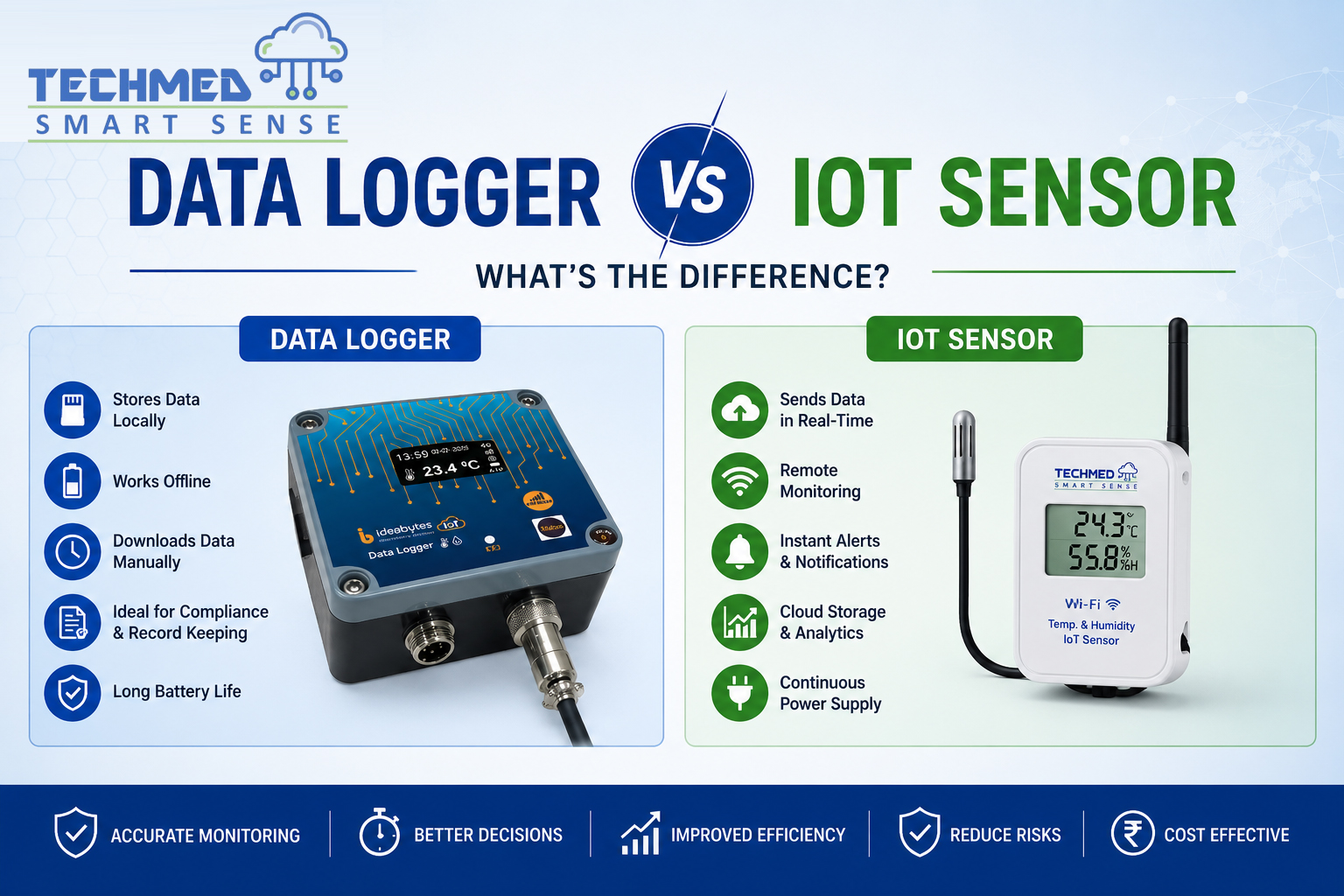
A data logger is a device that measures and records parameters such as temperature and humidity at regular intervals.
The information is usually stored inside the device and can later be downloaded for analysis and reporting.
Data loggers are commonly used for:
- Medical refrigerators
- Vaccine storage
- Blood banks
- Cold rooms
- Pharmaceutical warehouses
- Laboratories
- Food storage
If you are looking for reliable data loggers in Delhi, you can choose from offline, USB, Wi-Fi, and other connected solutions depending on your application.
What Is an IoT Sensor?
An IoT sensor does more than simply measure a parameter. It connects the sensor to a network so that information can be transmitted to a cloud platform or monitoring dashboard.
For example, an IoT temperature sensor installed inside a cold room can continuously send temperature information to an online dashboard.
If the temperature crosses a predefined limit, the system can send an alert to the responsible person.
A temperature monitoring device Delhi with IoT connectivity can therefore provide remote visibility without requiring someone to physically check the equipment.
Data Logger vs IoT Sensor
| Feature | Data Logger | IoT Sensor |
|---|---|---|
| Main Function | Records data | Measures and transmits data |
| Internet Required | Not always | Usually required |
| Data Storage | Internal memory | Cloud/platform |
| Remote Monitoring | Depends on model | Yes |
| Real-Time Alerts | Limited/available on smart models | Common |
| Data Download | USB/software/cloud | Online dashboard |
| Best For | Recording & reporting | Live monitoring |
When Should You Choose a Data Logger?
A data logger can be a good choice when you mainly need to record temperature and review the information later.
For example, an offline logger can be useful for:
- Transport monitoring
- Basic refrigerator monitoring
- Periodic quality checks
- Temporary monitoring
- Applications without reliable internet connectivity
For simple requirements, there may be no need to invest in a complete IoT system.
When Is an IoT Sensor Better?
An IoT sensor becomes more useful when you need continuous visibility.
For example, pharmaceutical companies may want to know immediately if the temperature inside a cold room changes during the night.
An IoT monitoring system can provide:
- 24/7 monitoring
- Remote access
- Instant alerts
- Cloud data storage
- Historical reports
- Multiple-location monitoring
This makes IoT particularly useful for critical environments where delayed detection can result in product loss.
Can a Data Logger Also Be an IoT Device?
Yes.
The two technologies are not always completely separate.
Modern data loggers can include Wi-Fi, 4G, Bluetooth, or other communication technologies. These devices can record data locally while also transmitting it to a remote platform.
This gives businesses the advantages of both data logging and remote monitoring.
Techmed Smart Sense offers connected monitoring solutions such as Wi-Fi and 4G data loggers for applications requiring remote access and alerts.
Which One Is Better for Your Business?
There is no universal answer.
Choose a data logger if you mainly need:
- Reliable data recording
- Simple operation
- Offline monitoring
- Portable monitoring
- Periodic reports
Choose an IoT sensor or connected data logger if you need:
- Real-time monitoring
- Remote access
- Automatic alerts
- Cloud storage
- Multiple-location monitoring
For critical pharmaceutical, healthcare, and cold-chain applications, remote monitoring can provide an additional layer of protection.
Why Choose Techmed Smart Sense?
Techmed Smart Sense provides temperature and environmental monitoring solutions for healthcare, pharmaceutical, laboratory, cold-chain, and industrial applications.
Solutions include:
- Temperature Data Loggers
- Wi-Fi Data Loggers
- 4G Remote Data Loggers
- Temperature & Humidity Monitoring
- Cold Room Monitoring
- Medical Refrigerator Monitoring
- Remote Monitoring Systems
With Smart Sense Data Logger Delhi, businesses can choose a monitoring solution based on their actual requirements instead of using the same technology for every application.
Conclusion
The main difference is simple:
A data logger focuses on recording data, while an IoT sensor focuses on connecting data and making it available remotely.
However, modern devices can combine both functions.
Before choosing a solution, consider your application, connectivity, monitoring frequency, alert requirements, data storage needs, and budget.
Whether you need a simple logger or a complete remote monitoring system, choosing the right technology can help protect temperature-sensitive products and improve operational control.
FAQs
What is the main difference between a data logger and an IoT sensor?
A data logger primarily records measurements, while an IoT sensor typically transmits measurements to a cloud or remote monitoring platform.
Can a data logger work without the internet?
Yes. Many offline data loggers store readings internally and do not require an internet connection.
Can IoT sensors send temperature alerts?
Yes. IoT-based monitoring systems can send alerts when temperature or humidity crosses predefined limits.
Which is better for pharmaceutical storage?
For critical pharmaceutical storage, a connected data logger or IoT monitoring system can be useful because it provides real-time visibility and alerts.
Does Techmed Smart Sense provide both solutions?
Techmed Smart Sense offers different temperature and environmental monitoring solutions, including data loggers and connected remote monitoring systems.