

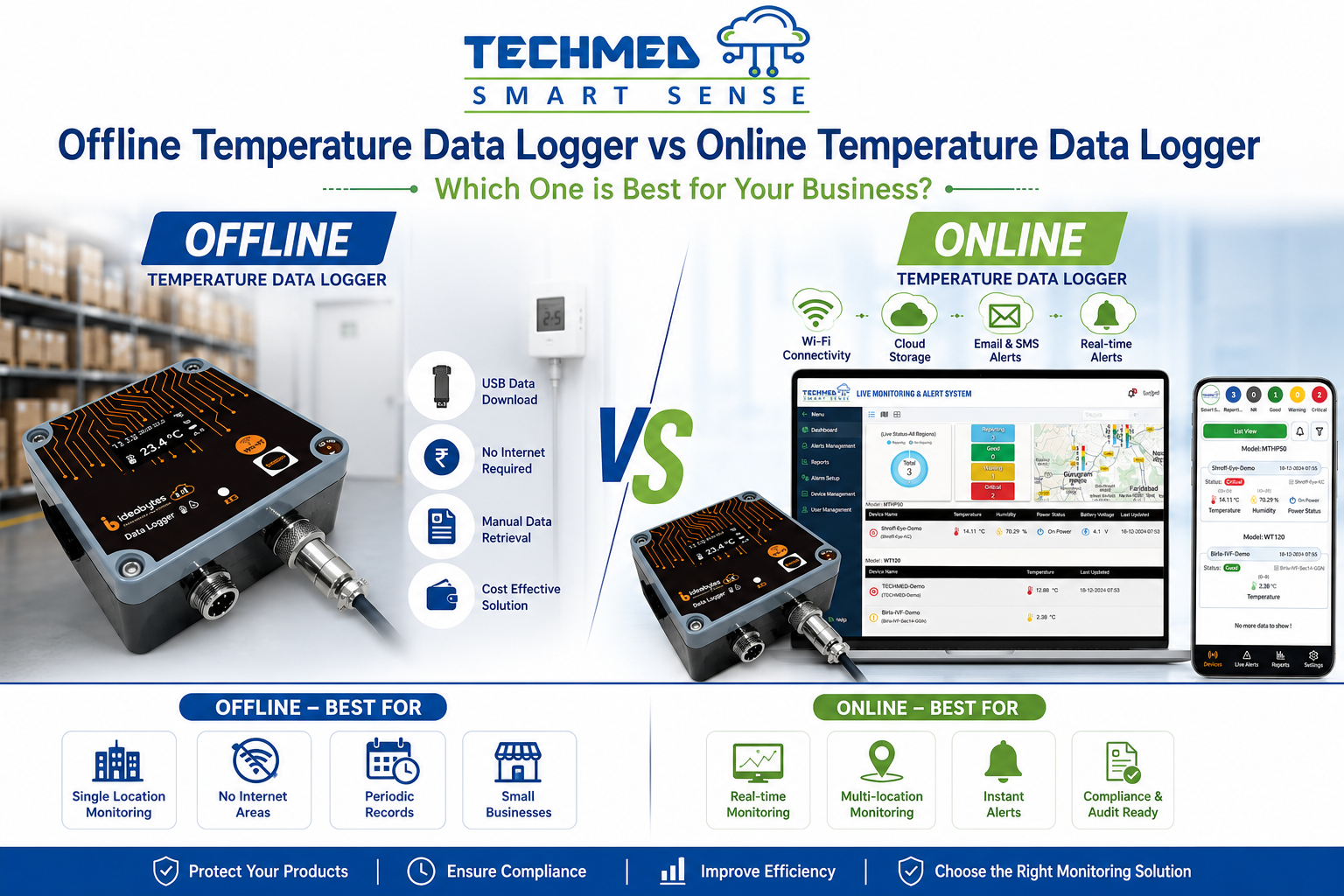
Maintaining the correct temperature is essential in industries such as pharmaceuticals, healthcare, laboratories, food processing, cold storage, and logistics. Even a slight temperature variation can lead to product spoilage, financial losses, or regulatory non-compliance.
This is where Temperature Data Loggers play a crucial role. However, businesses often face a common question:
Should you choose an Offline Temperature Data Logger or an Online Temperature Data Logger?
In this comprehensive guide, we’ll compare both technologies, their advantages, limitations, applications, and help you determine the right solution for your organization.
What is an Offline Temperature Data Logger?
An Offline Temperature Data Logger is a standalone device that records temperature readings internally. The recorded data is stored in the device’s memory and can later be downloaded to a computer using a USB cable or other connection method.
Since these devices do not require an internet connection, they are widely used in environments where continuous monitoring is not necessary.
Key Features
- Internal memory storage
- Battery operated
- No internet required
- USB data download
- PDF/Excel report generation
- Easy installation
- Cost-effective
What is an Online Temperature Data Logger?
An Online Temperature Data Logger continuously monitors temperature and transmits data in real-time through WiFi, Ethernet, GSM, or cloud connectivity.
Users can access live temperature readings from anywhere using a web dashboard or mobile application.
Key Features
- Real-time monitoring
- Cloud-based data storage
- Instant SMS & Email alerts
- Remote monitoring
- Multi-location monitoring
- Dashboard & Analytics
- Automatic reporting
Offline vs Online Temperature Data Logger Comparison
| Feature | Offline Data Logger | Online Data Logger |
|---|---|---|
| Internet Required | No | Yes |
| Real-Time Monitoring | No | Yes |
| Remote Access | No | Yes |
| Instant Alerts | No | Yes |
| Data Storage | Internal Memory | Cloud Storage |
| Monitoring | Manual | Automatic |
| Installation | Very Easy | Moderate |
| Cost | Lower | Higher |
| Maintenance | Minimal | Internet Required |
| Best For | Small Businesses | Large Organizations |
Advantages of Offline Temperature Data Logger
1. Cost-Effective
Offline loggers are more affordable, making them ideal for small businesses and laboratories.
2. Easy to Use
Simply place the device in the monitoring area and start recording. No internet or network setup is required.
3. Reliable in Remote Areas
Perfect for locations where WiFi or mobile connectivity is unavailable.
4. Low Maintenance
These devices consume very little power and require minimal maintenance.
5. Secure Local Storage
Data remains stored inside the device until downloaded.
Disadvantages of Offline Temperature Data Logger
- No real-time monitoring
- No remote access
- No instant alerts
- Manual data retrieval
- Delayed response to temperature excursions
Advantages of Online Temperature Data Logger
Real-Time Monitoring
Monitor temperature 24/7 from anywhere.
Instant Alerts
Receive SMS, Email, or WhatsApp notifications when temperatures exceed preset limits.
Cloud Storage
Automatically stores years of historical data securely.
Better Compliance
Supports WHO, GDP, GMP, NABL, ISO, and pharmaceutical audit requirements.
Remote Access
Monitor multiple facilities from one dashboard.
Automatic Reports
Generate PDF, Excel, and graphical reports instantly.
Disadvantages of Online Temperature Data Logger
- Higher initial investment
- Requires internet connectivity
- Slightly more complex setup
- Cloud subscription may apply (depending on the solution)
Applications of Offline Temperature Data Logger
Offline loggers are suitable for:
- Medical refrigerators
- Vaccine carriers
- Cold boxes
- Food transportation
- Warehouses
- Schools
- Laboratories
- Research projects
- Small clinics
- Portable equipment
Applications of Online Temperature Data Logger
Online loggers are ideal for:
- Pharmaceutical manufacturing
- Hospitals
- Blood banks
- Vaccine storage
- Cold chain logistics
- Diagnostic laboratories
- Food processing plants
- Cold storage warehouses
- Hotels
- Restaurants
- Industrial freezers
Which One Should You Choose?
Choose an Offline Temperature Data Logger if:
- You need a budget-friendly solution.
- Real-time monitoring is not required.
- You only need periodic temperature records.
- Internet connectivity is unavailable.
- You monitor a single location.
Choose an Online Temperature Data Logger if:
- You require 24/7 temperature monitoring.
- Compliance with GDP, GMP, or NABL standards is important.
- You manage multiple locations.
- Immediate alerts are critical.
- You need remote access and cloud reporting.
Why Businesses Are Moving to Online Monitoring
Modern industries are increasingly adopting online monitoring systems because they:
- Prevent product loss due to temperature excursions.
- Reduce manual monitoring efforts.
- Improve regulatory compliance.
- Enable centralized monitoring across multiple sites.
- Provide instant alerts for quick corrective action.
- Generate automated audit-ready reports.
Techmed Smart Sense Temperature Monitoring Solutions
At Techmed Smart Sense, we provide advanced temperature monitoring solutions designed for pharmaceutical companies, hospitals, laboratories, food industries, and cold chain applications.
Our solutions include:
- Offline Temperature Data Loggers
- WiFi Temperature Data Loggers
- Temperature & Humidity Data Loggers
- Cold Chain Monitoring Systems
- Cloud-Based Temperature Monitoring
- Real-Time Alert Systems
- Multi-Location Monitoring Solutions
Whether you need an economical offline solution or an advanced cloud-connected monitoring system, our experts can help you choose the right product for your application.
Frequently Asked Questions (FAQs)
Which is more accurate: Offline or Online Temperature Data Logger?
Both offer high accuracy when properly calibrated. The main difference lies in data access and monitoring capabilities.
Is an Offline Data Logger suitable for vaccine storage?
Yes, it is suitable for periodic monitoring. However, online monitoring is recommended for critical vaccine storage due to real-time alerts.
Does an Online Temperature Data Logger require WiFi?
Most online models use WiFi, Ethernet, GSM, or 4G connectivity to transmit data to the cloud.
Which data logger is better for pharmaceutical companies?
Online Temperature Data Loggers are generally preferred because they provide continuous monitoring, automated reports, and instant alerts to help meet regulatory requirements.
Can I monitor multiple locations with an Online Data Logger?
Yes. Cloud-based systems allow centralized monitoring of multiple facilities through a single dashboard.
Conclusion
Both Offline and Online Temperature Data Loggers serve essential roles in temperature monitoring. The right choice depends on your operational needs, budget, and compliance requirements.
If your priority is affordability and simple record-keeping, an Offline Temperature Data Logger is an excellent option. However, for organizations that require continuous monitoring, instant alerts, and regulatory compliance, an Online Temperature Data Logger provides a more comprehensive and future-ready solution.
Tags = Data Logger in Delhi, Temperature Data Logger in Delhi, IoT Temperature Monitoring in Delhi